
Roots out of the ground
Land Clearing Springfield MO: Grubbing and Root Raking in Springfield
Grubbing is the part of clearing that happens below the surface: stumps and roots out, so the ground can be built on.
- Springfield and 10 nearby townsGreene and Christian County, all within 20 miles
- Licensed, insured local contractorsWe work with them; ask for proof before work starts
- Written price firstPer-acre ranges published on every service page
- Calls answeredMonday to Saturday, 7am to 6pm
Land Clearing Springfield MO arranges grubbing and root raking around Springfield for building pads, driveways, ponds, septic areas and fields being turned to tillage. Grubbing pulls stumps and root balls out of the ground with an excavator or dozer; root raking combs the remaining roots, rock and debris out of the topsoil. It is the step that turns cleared ground into buildable ground, and the step that brings the county grading permit into play.
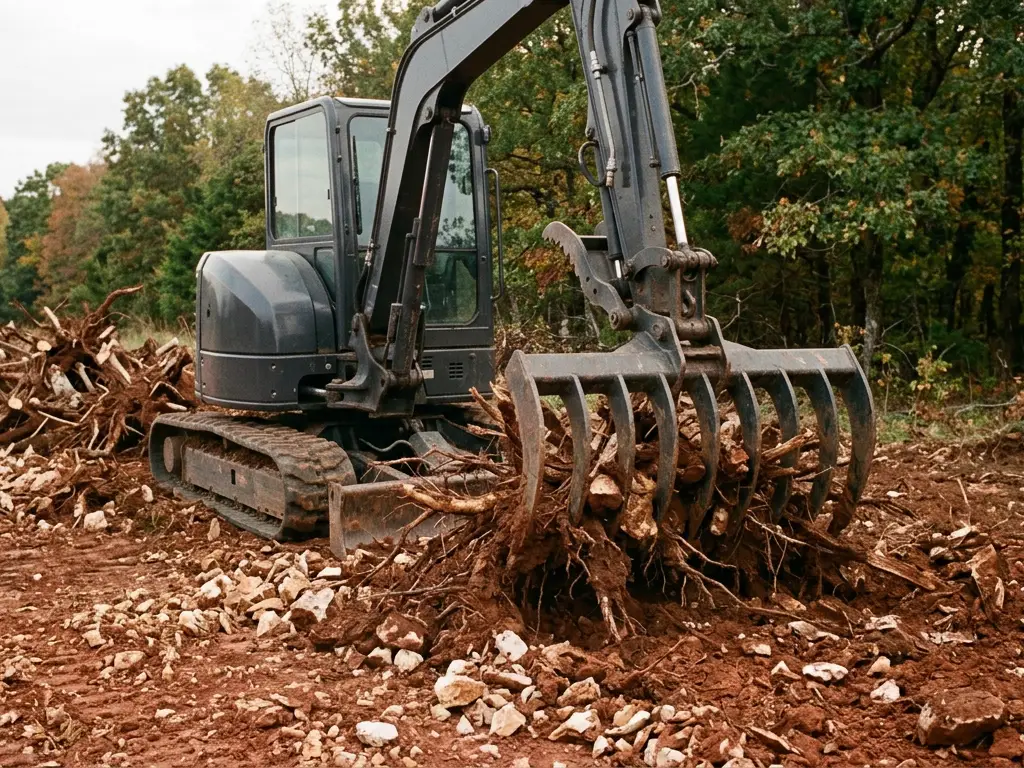
An excavator or dozer for grubbing runs $1,200 to $2,500 a day; skip it under a driveway or pad and the buried roots rot and sink, and a small home site that needed $2,000 to $5,000 of leveling needs it again.
Typical price
$1,200 to $2,500 a day
A bulldozer or excavator with an operator runs $1,200 to $2,500 a day and removes roots below ground (HomeGuide, September 2023). Grading a small home site afterward runs $2,000 to $5,000 on mostly level land, and far more on rocky ground (HomeGuide, November 2025).
Get a price: (417) 759-5914When the roots have to come out
- A slab, footing or drive will sit where trees stood
- A pond or septic area is going into wooded ground
- A field is going to be tilled, not just grazed
- The ground has to be graded for drainage
- Old stumps keep sprouting after mulching
- Buried fence, wire or rubble in the old tree line
Root rake, dozer or excavator
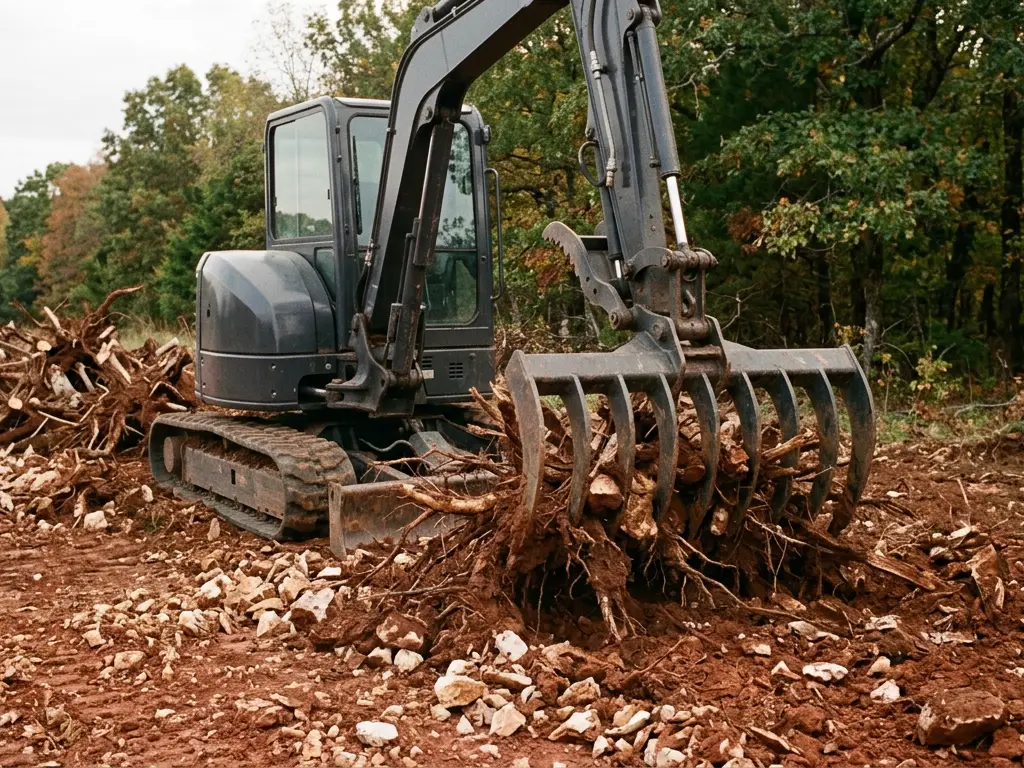
A root rake is a set of heavy curved tines on the front of an excavator or dozer. It lifts roots, stumps and rock and lets the soil fall through, so the topsoil stays on the site. An excavator is the precise tool for pulling individual stumps and working around trees that stay. A dozer with a rake covers open ground faster and windrows the debris. Most residential grubbing in this area is excavator work.
The grading permit starts here
This is the work the county permits are written for. Greene County and Christian County both require a permit for non-agricultural land disturbance and define it as anything that disturbs the root zone, and both use clearing with a dozer as their example of work that needs one. Over one acre, the Missouri Department of Natural Resources land disturbance permit applies as well, along with a stormwater pollution prevention plan.
Two Greene County rules matter for grubbing in particular. Existing ground cover stays in place within 25 feet of a sinkhole's flooding area during construction, with a silt barrier around the buffer, and any work in a mapped floodplain needs a floodplain development permit. The permit guide covers both.
Tell us the acreage and what is growing on it, and hear a typical price range before anyone drives out.
Call (417) 759-5914Chert, rock and the root rake
The Springfield Plateau's soils carry chert gravel, and some are mapped as gravelly from the surface, such as the Goss soils the USDA survey shows at the center of Ozark and Sparta. A root rake brings that rock up with the roots. Expect windrows of roots and rock at the edge of the work, and ask in the quote what happens to them: buried on site, burned where allowed, or hauled.
Leaving the soil usable
Grubbing done badly scrapes the topsoil off with the roots and leaves clay and chert to grow grass on. Done well, the roots are shaken out and the topsoil stays. Ask the operator how they keep topsoil on site, and seed or straw any area that will not be built on right away, because bare silt loam on a slope erodes in the first heavy rain.
Questions people ask
How much does grubbing and root raking cost?
A dozer or excavator with an operator runs $1,200 to $2,500 a day (HomeGuide). The number of days depends on stump count and size, rock, and how much area is being grubbed.
What are the signs ground needs grubbing rather than mulching?
If a slab, footing, drive, pond or septic area is going in, or the ground will be tilled or graded, the roots have to come out. Mulching leaves them in the ground.
Does grubbing need a permit in Greene County?
Usually yes for non-agricultural work. Grubbing disturbs the root zone, which is what triggers Greene County's grading permit, and sites over one acre also need the state land disturbance permit.
What is the difference between grubbing and root raking?
Grubbing pulls stumps and root balls. Root raking follows, combing the remaining roots, rock and debris out of the soil while letting the dirt fall back.
What happens to the stumps and roots afterward?
They are windrowed and then buried on site, burned where the rules allow, or hauled away. Agree which in the quote, because hauling adds cost.
Often done together
- Home site clearingA pad, a driveway and room for the septic field, cleared down to bare ground with the roots out, so the builder starts on something solid.
- Stump grindingA ground stump disappears under the lawn. Leaving it costs a mower blade a year and a sprout every spring.
- Commercial land clearingOn a commercial site the clearing has to fit the permit, the stormwater plan and the grading schedule. The machine work is the easy part.
- Land Clearing Springfield MO: Land Clearing in OzarkRockier ground than Springfield, a river through the middle of town, and the county permit office down the road.
Tell us what is growing and how much of it
Say roughly how many acres, what has taken over (cedar, honeysuckle, brush, saplings, a grown-in fence row) and what you want the ground to become. You will hear which method usually fits and what it tends to cost per acre before anyone drives out.
Call (417) 759-5914