
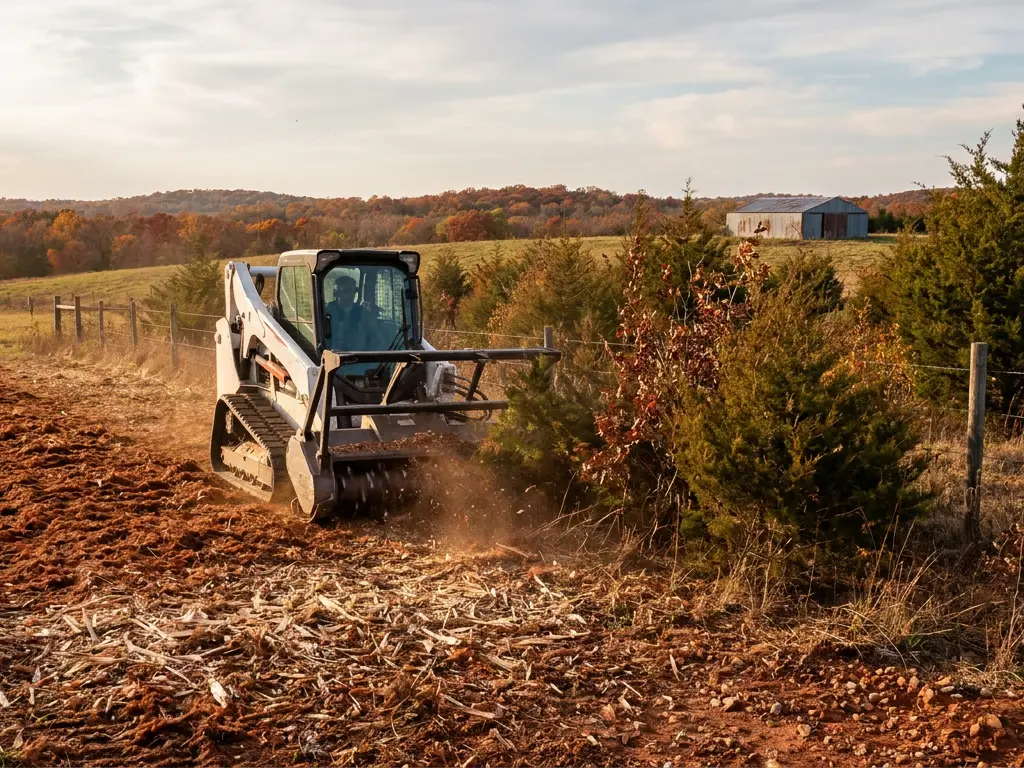
Eastern red cedar
Land Clearing Springfield MO: Cedar Tree Removal in Springfield
Cedar is the tree that takes Ozarks pasture back. It does not resprout from a stump, which makes it the most satisfying thing to clear.
- Springfield and 10 nearby townsGreene and Christian County, all within 20 miles
- Licensed, insured local contractorsWe work with them; ask for proof before work starts
- Written price firstPer-acre ranges published on every service page
- Calls answeredMonday to Saturday, 7am to 6pm
Land Clearing Springfield MO arranges eastern red cedar removal for landowners around Springfield whose pasture, hay ground, glades or fence rows are filling with cedar. Cedar is a native tree, but on open ground left without fire or regular mowing it spreads fast, shades out grass and turns a field into a thicket within a couple of decades. The Missouri Department of Conservation describes cedar encroachment on glades and grasslands as one of the state's main conservation challenges.
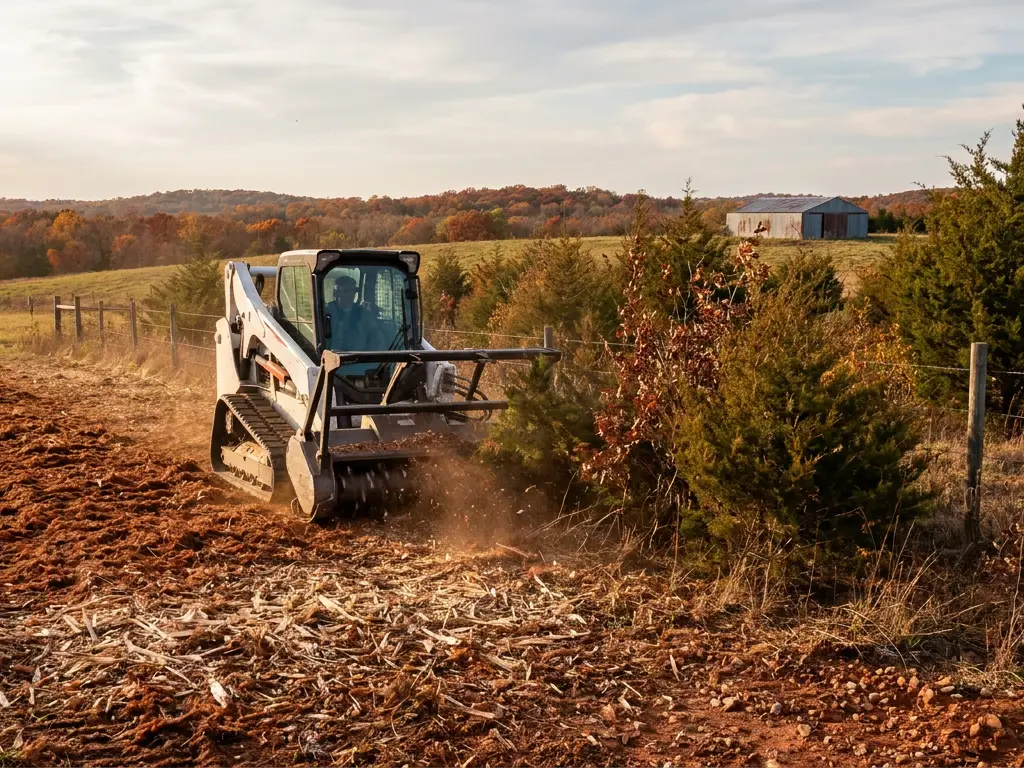
Mulching scattered cedar seedlings out of a pasture averages $400 to $800 an acre; wait until they close into a stand and it becomes moderate clearing at $2,500 to $4,500 an acre, with the grass already gone underneath.
Typical price
$2,500 to $4,500 an acre
Clearing an established cedar stand with thicker undergrowth and medium-sized trees runs $2,500 to $4,500 an acre (HomeGuide moderate clearing, November 2025). Scattered young cedar in a pasture is mulching work at $400 to $800 an acre. Large single cedars near a house or fence are priced as tree removal, $400 to $1,200 each.
Get a price: (417) 759-5914How cedar takes over a field
- Knee-high cedar seedlings scattered through the grass
- A dark green band creeping in from the fence rows
- Grass thinning and dying out under older cedars
- Bare, needle-covered ground where the trees have closed in
- Cedar spreading along the line where birds perch
- Glades and rocky openings filling in with trees
Why cedar spreads, and why it is worth catching early
Birds eat the blue berry-like cones of female cedars and drop the seeds along fence lines, under power lines and across any open field. Without fire or regular mowing, every seedling survives. Cedar is evergreen, so it shades the ground all year, and dense stands leave little grass beneath them.
The upside is that cedar does not resprout from a cut stump. A cedar cut below its lowest green branch is dead. That makes cedar the one invader where a single thorough clearing really works, as long as the seed trees along the edges come out too.
The method depends on the size of the cedar
Small and medium cedar are ideal mulcher work: the head grinds them to chips, and the cedar mulch is slow to rot and smells for weeks. For larger cedar the usual approach is to cut and stack, then mulch or burn the brush and keep or sell the logs. On glades and rocky openings, the Missouri Department of Conservation recommends chainsaw removal so the thin soil and glade plants are not disturbed by machines.
Tell us the acreage and what is growing on it, and hear a typical price range before anyone drives out.
Call (417) 759-5914Cost-share for cedar removal
The Missouri Department of Conservation works with landowners on cedar removal, glade restoration and prescribed burning, and has helped landowners receive cost-share money to pay contractors to cut cedar off glades. Federal programs through the Natural Resources Conservation Service also fund brush management. If the land might qualify, talk to the MDC private land conservationist for your county before hiring, because work done before approval usually is not reimbursed.
Keeping a pasture clear of cedar
Once the stand is gone, the job is to stop new seedlings. Mowing or bush hogging once a year, rotational grazing that keeps grass thick, and removing the female seed trees along the fence rows all help. Pastures around Willard and Ash Grove that were cleared once and then left show the pattern: a ring of cedar marching in from the fence, about one row a year.
Questions people ask
How much does it cost to remove cedar trees from pasture?
Scattered young cedar is mulching work at $400 to $800 an acre. An established stand runs $2,500 to $4,500 an acre (HomeGuide). Large single trees near structures cost $400 to $1,200 each.
What are the signs cedar is taking over my pasture?
Seedlings scattered through the grass, a dark green band spreading in from the fence lines, and thinning grass under older trees. By the time the trees touch, the grass underneath is mostly gone.
Will cedar grow back after it is cut?
Not from the stump. Cedar cut below its lowest green branch dies. New cedar comes from seed, so remove the seed trees along the edges and mow or graze to stop seedlings.
Is there cost-share for cedar removal in Missouri?
The Missouri Department of Conservation has helped landowners with cost-share for cedar removal on glades, and NRCS programs fund brush management. Ask before work starts, because work done before approval usually does not count.
Can cedar mulch be left on the pasture?
Yes, in a thin layer. It breaks down slowly and suppresses grass where it is thick, so overseed in early fall and avoid deep piles.
Often done together
- Forestry mulchingOne machine cuts, grinds and spreads brush and small trees as mulch. No piles, no burning, no bare dirt.
- Pasture reclamationA hay field or pasture lost to brush can be grazed again within a season, if the clearing is followed by seed and a mower.
- Fence line clearingA fence row grows in faster than the field beside it. Clearing a strip either side of the wire gets the fence back.
- Land Clearing Springfield MO: Land Clearing in WillardPasture country with cedar coming in from the fence rows, and soils that drain well enough to work most of the year.
Tell us what is growing and how much of it
Say roughly how many acres, what has taken over (cedar, honeysuckle, brush, saplings, a grown-in fence row) and what you want the ground to become. You will hear which method usually fits and what it tends to cost per acre before anyone drives out.
Call (417) 759-5914