
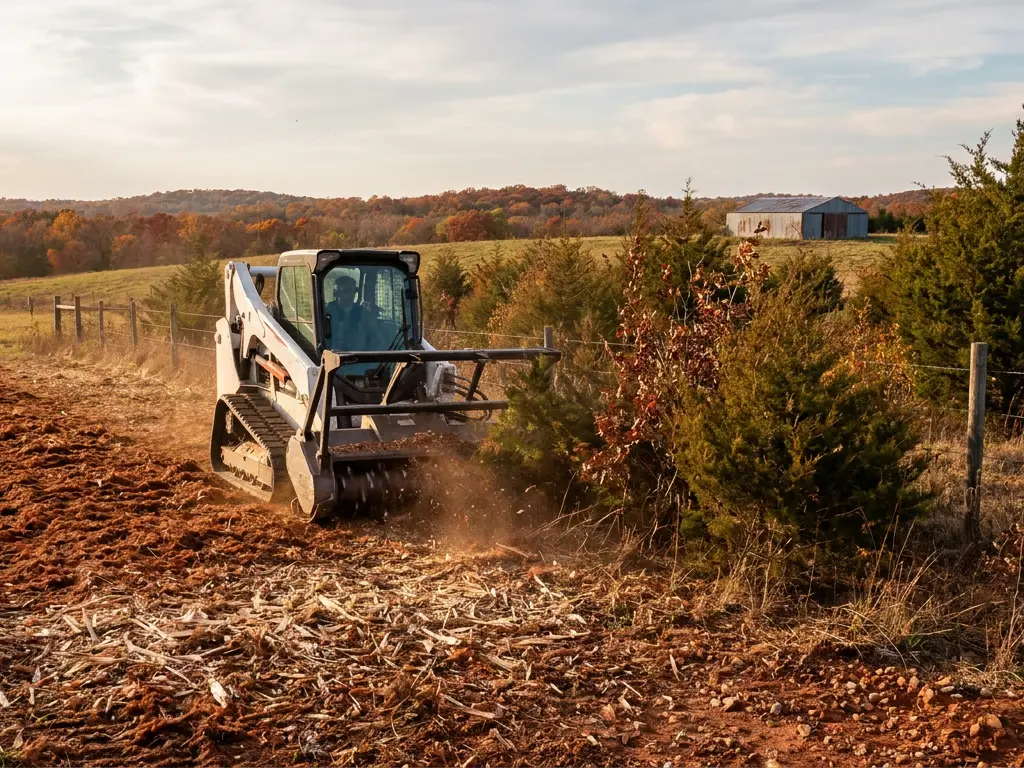
Ground in place
Land Clearing Springfield MO: Forestry Mulching in Springfield
One machine cuts, grinds and spreads brush and small trees as mulch. No piles, no burning, no bare dirt.
- Springfield and 10 nearby townsGreene and Christian County, all within 20 miles
- Licensed, insured local contractorsWe work with them; ask for proof before work starts
- Written price firstPer-acre ranges published on every service page
- Calls answeredMonday to Saturday, 7am to 6pm
Land Clearing Springfield MO arranges forestry mulching across Springfield and the Greene and Christian County towns around it, for pasture edges, fence rows, overgrown acreage, hunting ground and wooded lots. A forestry mulcher grinds standing brush, cedar and saplings into a layer of chips and spreads it over the ground in a single pass, so the topsoil stays where it is and nothing has to be hauled away or burned.
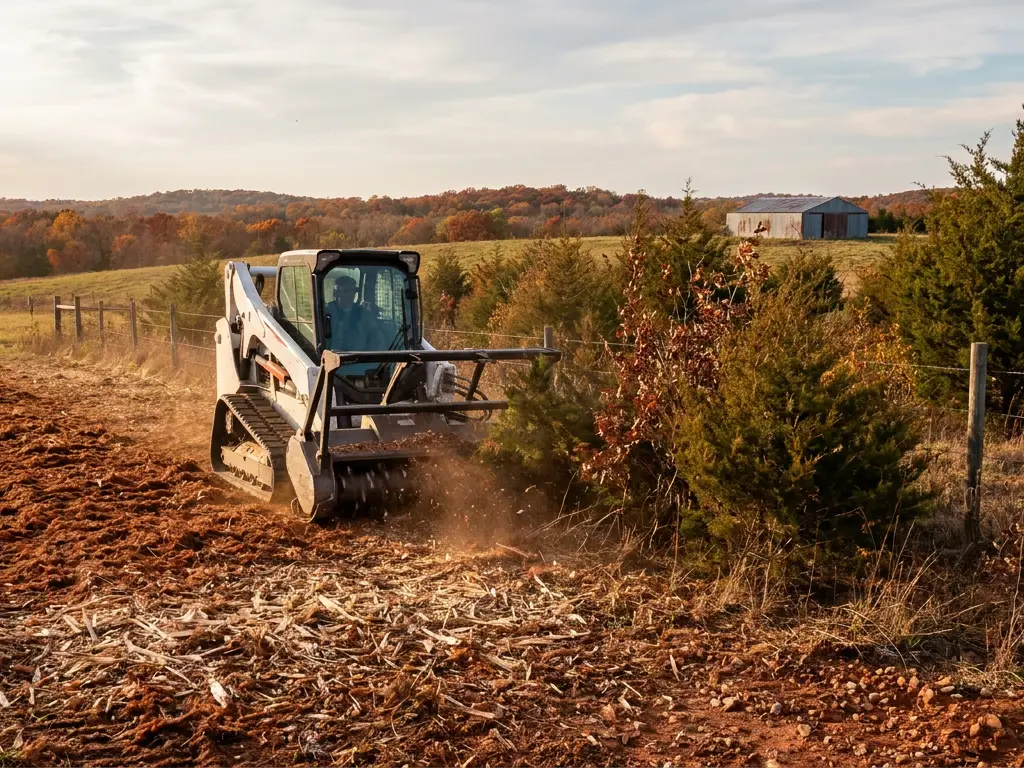
Mulching brush and saplings averages $400 to $800 an acre; wait until they are trees and the same ground needs full clearing at $2,500 to $4,500 an acre, with stumps, piles and possibly a permit added.
Typical price
$400 to $800 an acre
Forestry mulching averages $400 to $800 an acre and runs up to $2,000 an acre on dense overgrowth (HomeGuide, September 2023). Billed by time it is $125 to $300 an hour, or $1,000 to $2,500 a day with an operator. Minimum charges of $400 to $600 and a $150 to $300 mobilization fee are common on small jobs.
Get a price: (417) 759-5914Ground that is ready for a mulcher
- Cedar and sumac spreading in from the edges of a pasture
- Brush grown up through a fence you used to walk
- Saplings too thick for a bush hog to push over
- Woods you cannot see into or walk through
- Old brush piles nobody ever burned
- A field that was hayed ten years ago and is now thicket
How a forestry mulcher works
The machine is usually a tracked skid steer or a purpose-built mulching tractor carrying a cutting head across the front. A drum mulcher spins a horizontal drum fitted with carbide or steel teeth and makes a fine mulch; it can grind a stump down to the ground. A disc mulcher spins a heavy flat disc and works faster through standing trees, but the mulch is coarser and stumps stay visible. On most Springfield-area jobs the drum is the better fit, because the chert in the soil chews up teeth either way and a finer mulch hides the ground faster.
A skid steer mulcher typically covers 1 to 3 acres a day depending on density, and a larger mulching tractor can cover up to 15 acres a day on open ground (HomeGuide). Tracked machines matter here: they float over wet silt loam and grip on the slopes along every creek.
What it handles and what it does not
Mulching is the right tool for brush, briars, honeysuckle, cedar and hardwood saplings, and trees up to roughly the size the operator's head is rated for. It is the wrong tool for a house pad or a driveway, because the roots stay in the ground and will rot and settle under anything built on them. For a building site, mulching usually comes first and grubbing and root raking follows.
Big trees are usually cut and handled separately. Ask the contractor what diameter their head will take and what happens to anything larger.
Tell us the acreage and what is growing on it, and hear a typical price range before anyone drives out.
Call (417) 759-5914Why mulching rarely needs a grading permit
Greene County and Christian County both require a permit for non-agricultural work that disturbs the root zone of existing vegetation, and both give the example that clearing trees with a dozer needs one while clearing with a chainsaw does not. A mulcher that cuts above ground and leaves the roots is much closer to the chainsaw case than the dozer case. That is a reason to confirm with the county for your property, not a promise: grinding stumps below grade or grading afterward changes the answer.
After the mulch is down
The mulch layer suppresses regrowth for a season or two, holds soil on slopes and breaks down into organic matter. Cedar does not resprout from a stump, but hardwoods and honeysuckle do, so plan a follow-up: mowing with a bush hog once or twice a year, a cut-stump herbicide on resprouts, or grazing. On pasture, overseeding fescue or a clover mix into the mulch in early fall closes the ground fastest.
Questions people ask
How much does forestry mulching cost per acre?
Forestry mulching averages $400 to $800 an acre and up to $2,000 an acre on dense overgrowth (HomeGuide). By the hour it runs $125 to $300, and most contractors carry a minimum charge of $400 to $600.
What are the signs my land is ready for forestry mulching?
Brush and saplings too thick for a bush hog, cedar spreading into open ground, a fence row you cannot walk, or woods too dense to see into. If the stems are mostly under a few inches across, mulching is usually the cheapest way to clear them.
Does forestry mulching remove stumps?
A drum mulcher grinds stumps to about ground level. It does not pull roots out of the ground. If you are building, the stumps and roots usually have to be grubbed out after mulching.
Will the brush grow back after mulching?
Cedar will not resprout from a cut stump. Hardwood saplings, sumac and bush honeysuckle will, so plan on mowing, grazing or a cut-stump herbicide treatment for the next season or two.
Do I need a permit for forestry mulching in Greene County?
Greene County requires a grading permit for non-agricultural work that disturbs the root zone. Mulching that leaves roots in place is usually treated differently from dozer clearing, but confirm with Resource Management for your property, especially near a sinkhole or in a mapped floodplain.
Often done together
- Underbrush clearingClear the understory and leave the canopy: a park-like woods you can see into, walk through and hunt.
- Cedar tree removalCedar is the tree that takes Ozarks pasture back. It does not resprout from a stump, which makes it the most satisfying thing to clear.
- Pasture reclamationA hay field or pasture lost to brush can be grazed again within a season, if the clearing is followed by seed and a mower.
- Fence line clearingA fence row grows in faster than the field beside it. Clearing a strip either side of the wire gets the fence back.
Tell us what is growing and how much of it
Say roughly how many acres, what has taken over (cedar, honeysuckle, brush, saplings, a grown-in fence row) and what you want the ground to become. You will hear which method usually fits and what it tends to cost per acre before anyone drives out.
Call (417) 759-5914