
North-northeast of Springfield
Land Clearing Springfield MO: Land Clearing in Fair Grove
Acreage and creek-bottom ground in northern Greene County, where the floodplain map matters as much as the brush.
- Springfield and 10 nearby townsGreene and Christian County, all within 20 miles
- Licensed, insured local contractorsWe work with them; ask for proof before work starts
- Written price firstPer-acre ranges published on every service page
- Calls answeredMonday to Saturday, 7am to 6pm
Land Clearing Springfield MO arranges land clearing in and around Fair Grove, the Greene County town of about 1,600 people (2020 Census) roughly 15 miles north-northeast of central Springfield. The land around it is larger acreage than the towns close to Springfield: pasture, hay ground and woods, with creek bottoms running through it.
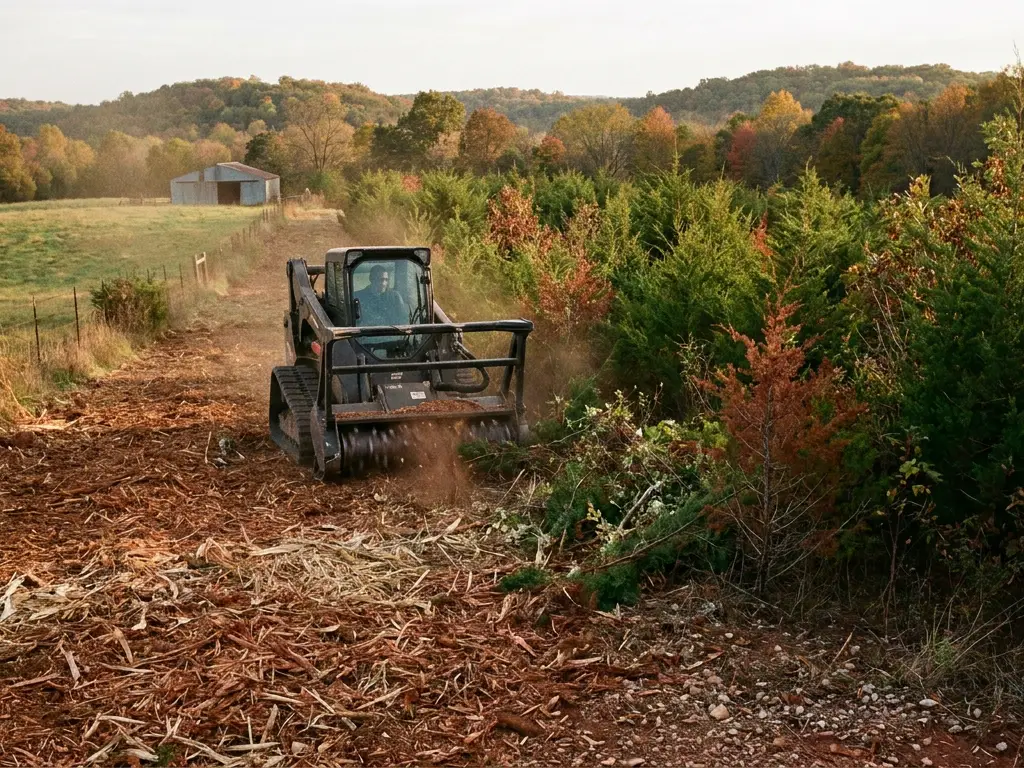
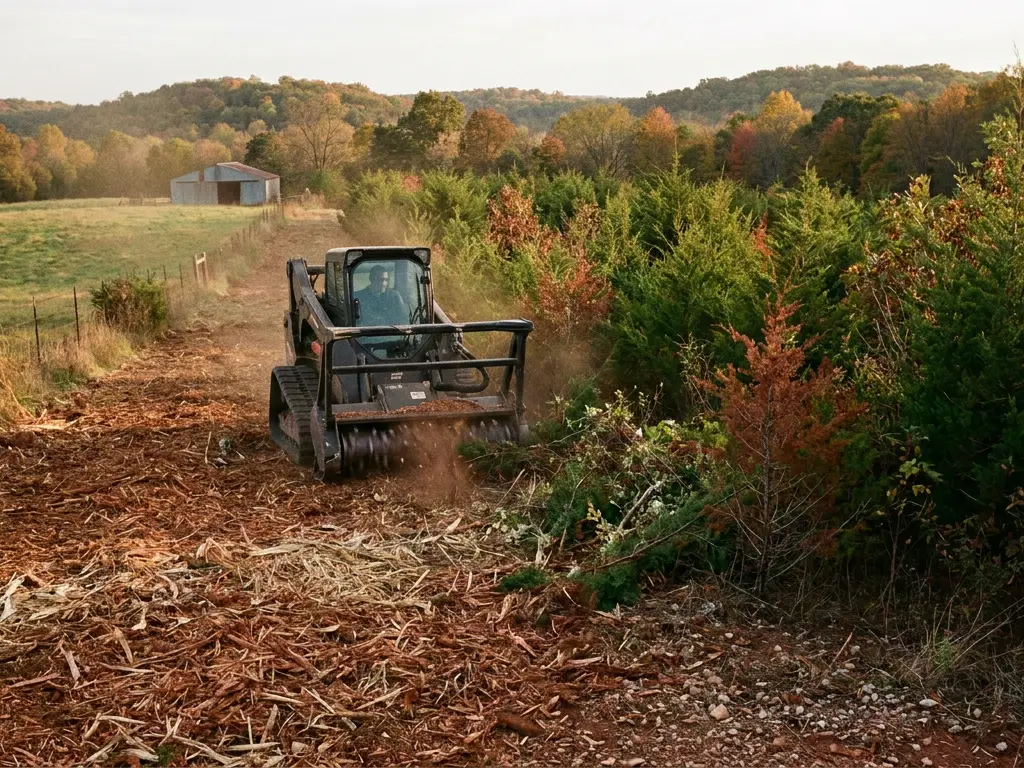
Mulching a creek-bottom field around Fair Grove with the roots left in runs $400 to $800 an acre; grub and grade the same field inside a mapped floodplain without the floodplain development permit and the project stops while the county sorts it out, with the soil already loose for the next flood.
Typical price
$1,200 to $8,000 an acre
Land clearing typically runs $1,200 to $8,000 an acre (HomeGuide, November 2025), and five acres $4,500 to $35,000 depending on density. Forestry mulching alone averages $400 to $800 an acre, and larger jobs usually come in lower per acre.
Get a price: (417) 759-5914Typical overgrown ground around Fair Grove
- Creek-bottom fields grown up in sycamore and brush
- Upland pasture with cedar spreading from the edges
- Woods thick with honeysuckle and saplings
- Fence lines lost across larger tracts
- Gravel bars and wash-outs along the creeks
- Old farm lanes closed in with trees
Cedargap soils and the creek bottoms
The USDA soil survey maps the center of Fair Grove as Cedargap silt loam on 1 to 3 percent slopes, frequently flooded. It is a well-drained creek-bottom soil, classed as loamy-skeletal, meaning it carries a lot of gravel. It drains quickly between floods, which makes it workable, but it does flood, and the gravel wears cutting teeth.
On ground like that, the rule is to keep the soil covered. Mulching leaves roots and chips in place to hold it through the next high water. Grubbing a creek bottom to bare gravel invites the creek to take it.
The floodplain permit
Greene County requires a floodplain development permit for any activity within the Special Flood Hazard Area, the mapped floodplain. That is separate from the grading permit, which covers non-agricultural land disturbance elsewhere. Check the county's floodplain map before clearing any creek-bottom ground, and talk to Resource Management before any grubbing or grading there.
Tell us the acreage and what is growing on it, and hear a typical price range before anyone drives out.
Call (417) 759-5914Groundwater and karst
Greene County's hazard mitigation plan notes that Fair Grove's public water supply, established in 1968, draws on wells in the Springfield Plateau and deep Ozark aquifers. On karst ground, what runs off a cleared site can reach groundwater quickly through sinkholes and fractures, which is why the county's design standards keep ground cover in place within 25 feet of a sinkhole's flooding area during construction.
Larger tracts
Fair Grove jobs tend to be bigger, which brings the per-acre price down. Plan the tract on an aerial photo before asking for a quote, mark what becomes pasture and what stays wooded, and ask for the price broken out by area. Acreage clearing covers how those quotes are put together.
Questions people ask
How much does land clearing cost near Fair Grove?
Most clearing runs $1,200 to $8,000 an acre, and five acres $4,500 to $35,000 depending on density (HomeGuide). Larger tracts usually come in lower per acre.
What are the signs my Fair Grove acreage needs clearing?
Cedar spreading from pasture edges, creek-bottom fields growing up in brush and saplings, fence lines lost, and old lanes closed in with trees.
Do I need a permit to clear land in a floodplain?
Yes, for any activity in the mapped Special Flood Hazard Area: Greene County requires a floodplain development permit there, separate from the grading permit.
Should creek-bottom ground be mulched or grubbed?
Usually mulched. Leaving roots and mulch in place holds the soil through the next flood. Grubbing it bare invites erosion.
Is clearing cheaper per acre on large tracts?
Usually. The machine is moved in once and works more efficiently across larger areas, so the per-acre price drops as acreage grows.
Common jobs here
- Acreage clearingMulti-acre jobs are priced by density and access, not just size, and they get cheaper per acre as they grow.
- Forestry mulchingOne machine cuts, grinds and spreads brush and small trees as mulch. No piles, no burning, no bare dirt.
- Pasture reclamationA hay field or pasture lost to brush can be grazed again within a season, if the clearing is followed by seed and a mower.
- Trail and right-of-way clearingA trail, a lane or a power line corridor is clearing in a line: narrow, long, and priced by how far the machine travels in a day.
Tell us what is growing and how much of it
Say roughly how many acres, what has taken over (cedar, honeysuckle, brush, saplings, a grown-in fence row) and what you want the ground to become. You will hear which method usually fits and what it tends to cost per acre before anyone drives out.
Call (417) 759-5914