
Five acres and up
Land Clearing Springfield MO: Acreage Clearing Around Springfield
Multi-acre jobs are priced by density and access, not just size, and they get cheaper per acre as they grow.
- Springfield and 10 nearby townsGreene and Christian County, all within 20 miles
- Licensed, insured local contractorsWe work with them; ask for proof before work starts
- Written price firstPer-acre ranges published on every service page
- Calls answeredMonday to Saturday, 7am to 6pm
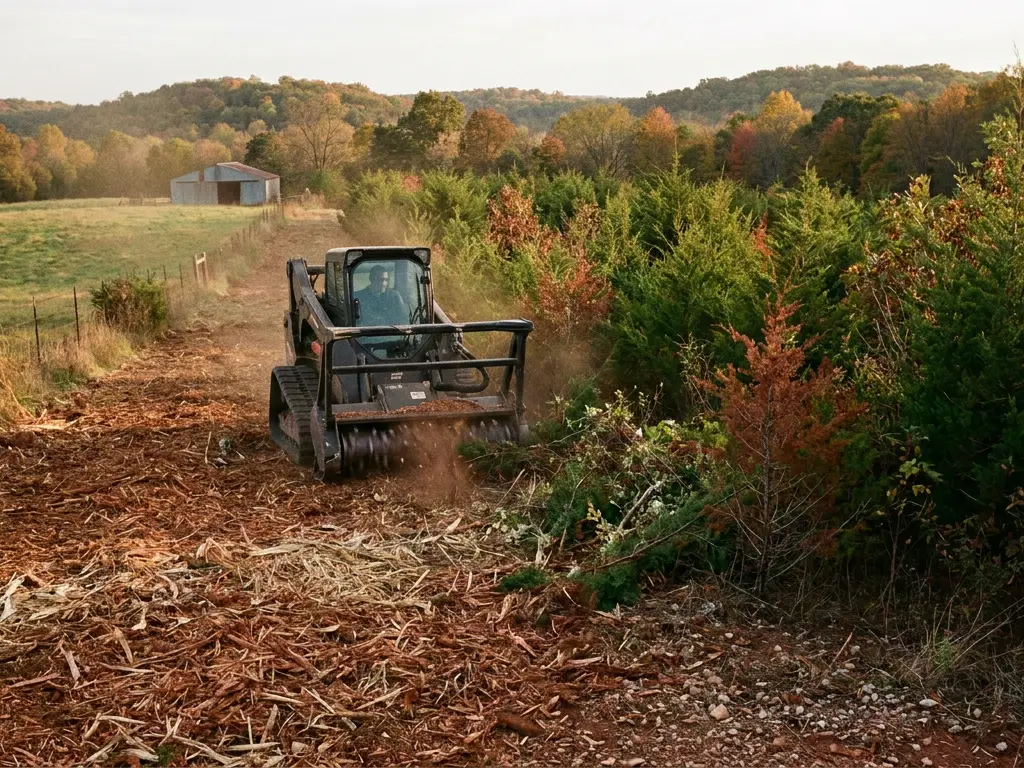
Land Clearing Springfield MO arranges acreage clearing for landowners around Springfield with five, twenty or a hundred acres that have grown up in brush, cedar or second-growth woods. Most of these jobs are a mix: mulching on the open ground, selective thinning in the woods, a cleared fence line around the outside and a few areas grubbed for a building, a pond or a food plot.
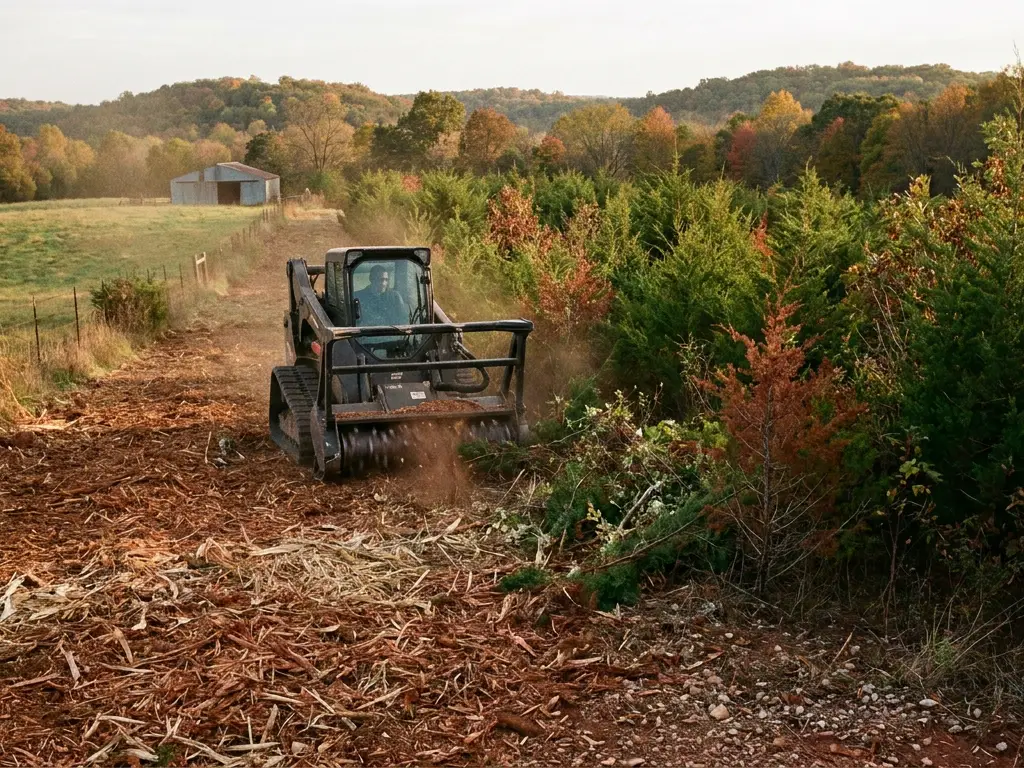
Clearing five acres of light brush runs about $6,000 to $12,500 at light-clearing rates; let the same five acres grow into dense woods and the bill climbs toward $22,500 to $40,000 at heavy-clearing rates.
Typical price
$4,500 to $35,000 for five acres
Five acres typically run $4,500 to $35,000 to clear, depending on what is growing (HomeGuide, November 2025). Per acre, light clearing is $1,200 to $2,500, moderate $2,500 to $4,500 and heavy $4,500 to $8,000. Forestry mulching alone averages $400 to $800 an acre. Larger jobs usually come in lower per acre because the machine is moved once.
Get a price: (417) 759-5914What overgrown acreage usually looks like here
- Old pasture gone to cedar and broomsedge
- Woods so thick with honeysuckle that deer trails are the only way through
- Fence lines lost under trees
- A pond with brush and saplings down to the water
- Gullies and washes nobody can mow around
- Property corners you cannot find
Pricing a big job
On acreage, the contractor's real costs are machine hours and fuel, so the price follows how long the machine spends on each acre. That depends on density, tree size, slope, rock and how far the work is from where the trailer can park. A forty-acre farm that is mostly open with cedar along the edges can cost less in total than ten acres of solid second growth.
Ask for the price broken down by area: so many acres mulched, so much fence line, so many acres thinned. It makes the quote comparable and lets you cut an area if the total is too high.
Planning the land before the machine arrives
The cheapest acreage jobs start with a plan on an aerial photo: which areas become pasture, which become open woods, where the trails, food plots and fence lines go, and which trees are worth keeping. Greene County's online assessor map and the city's map viewer both show recent aerials, and either is good enough to sketch on.
Leave the steep draws and creek banks wooded where you can. They are the slowest ground to clear, the most likely to erode afterward, and in a mapped floodplain any soil disturbance needs a floodplain development permit in both Greene and Christian County.
Tell us the acreage and what is growing on it, and hear a typical price range before anyone drives out.
Call (417) 759-5914Timing on large tracts
Big jobs go best in late fall and winter, when the leaves are down, the ground is firmer and the operator can see what they are cutting. On land where the work is paid through a federal cost-share program, Missouri's Natural Resources Conservation Service policy has restricted cutting potential bat roost trees, those over 9 inches in diameter with loose bark or cracks, during the summer months, so ask the program office for the current window. The timing guide covers the seasons in detail.
Farms at the edge of the service area
Much of the acreage work sits around the smaller towns: north toward Fair Grove and Willard, east around Strafford and Rogersville, and south past Sparta. The land changes quickly across that ring, from creek-bottom soils that flood to gravelly chert ridges, and the right machine changes with it.
Questions people ask
How much does it cost to clear five acres?
Five acres typically run $4,500 to $35,000 depending on density (HomeGuide, November 2025). Mostly brush sits near the bottom; solid mature woods sit near the top.
What are the signs my acreage needs clearing?
Pasture turning to cedar, fence lines lost under trees, woods too thick to walk, and saplings that a bush hog can no longer push over. Each year of growth moves the job into a higher price band.
Is clearing cheaper per acre on bigger jobs?
Usually. The machine is hauled in once, and the operator works more efficiently across larger areas, so per-acre prices drop slightly as acreage grows.
How long does it take to clear 20 acres?
It depends on density. A skid steer mulcher covers roughly 1 to 3 acres a day and a mulching tractor up to 15 on open ground, so 20 acres can take anywhere from a few days to a few weeks.
Do I need a permit to clear farm acreage?
Normal agricultural activity is exempt from the county grading permits, but clearing for development is not, and work in a mapped floodplain needs a floodplain development permit. Ask the county office before grubbing.
Often done together
- Forestry mulchingOne machine cuts, grinds and spreads brush and small trees as mulch. No piles, no burning, no bare dirt.
- Pasture reclamationA hay field or pasture lost to brush can be grazed again within a season, if the clearing is followed by seed and a mower.
- Underbrush clearingClear the understory and leave the canopy: a park-like woods you can see into, walk through and hunt.
- Land Clearing Springfield MO: Land Clearing in Fair GroveAcreage and creek-bottom ground in northern Greene County, where the floodplain map matters as much as the brush.
Tell us what is growing and how much of it
Say roughly how many acres, what has taken over (cedar, honeysuckle, brush, saplings, a grown-in fence row) and what you want the ground to become. You will hear which method usually fits and what it tends to cost per acre before anyone drives out.
Call (417) 759-5914